
Imagine you’re on a new DEX, liquidity looks deep, and gas is low — a classic trade entry. You click “Connect Wallet,” sign the transaction, and a minute later realize a token approval you never intended let a malicious contract drain funds. That scenario is not rare; blind signing and confusing approvals have been root causes of losses across DeFi. For experienced users who move assets across chains and use multiple dApps, the problem isn’t whether to sign but how to sign intelligently.
This article explains the mechanism behind a specific mitigation strategy: pre-transaction simulation and risk scanning as implemented in Rabby Wallet. I’ll unpack how these layers work, why they matter for US-based DeFi participants who juggle many EVM chains, where the approach breaks down, and practical heuristics you can adopt today to reduce protocol-level exposure without sacrificing speed.
Mechanics: What Rabby’s simulation and scanning actually do
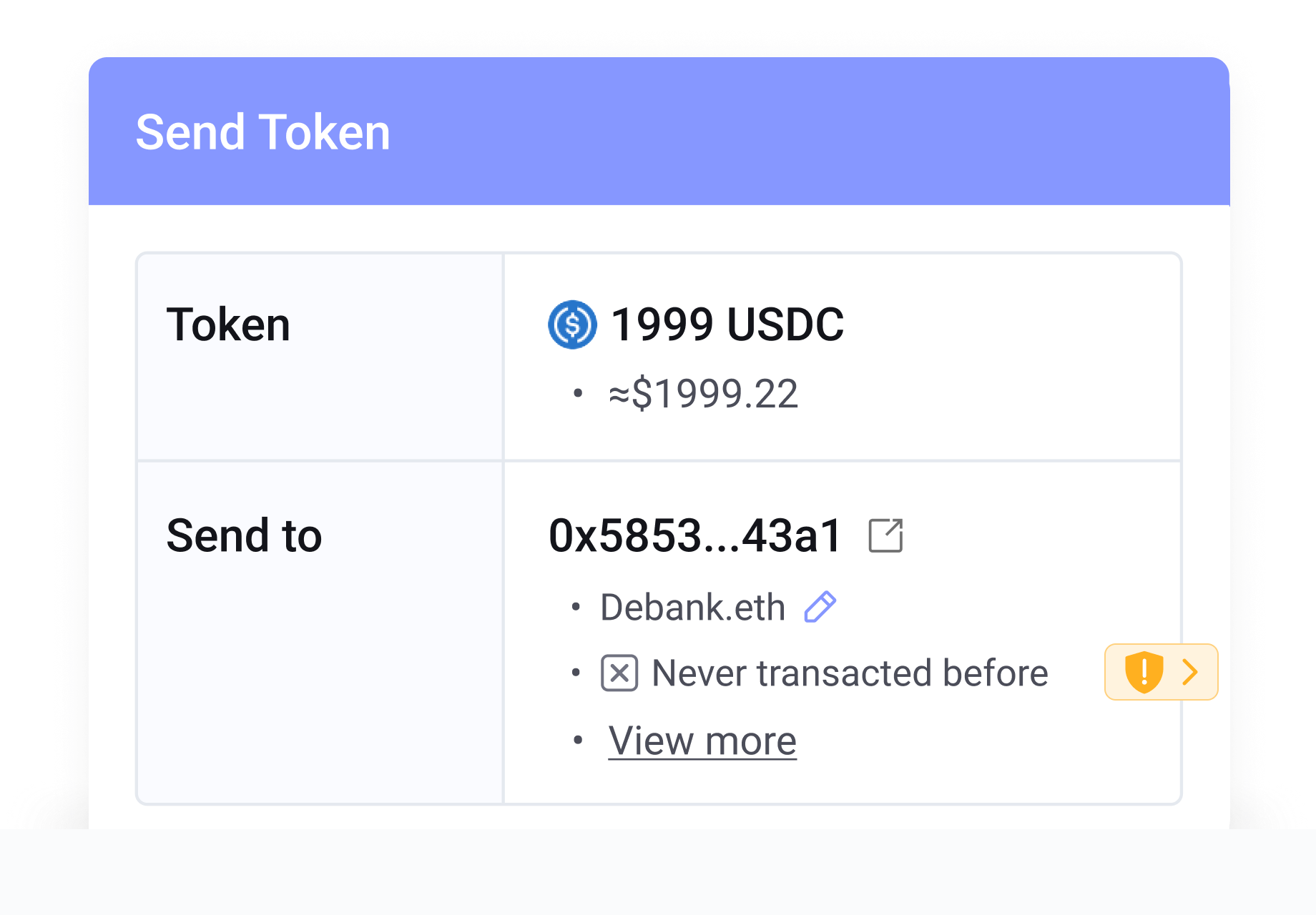
At a low level a wallet’s job is simple: create, sign, and submit transactions. Rabby inserts a deterministic pre-signing step that simulates the transaction on a local or remote node and runs several analyses on the simulated result. The simulation shows the expected token balance changes, gas cost, and whether approvals or transfers will alter allowances. Layered on top is a security engine that cross-references contract addresses and patterns against known-vulnerable contracts, suspicious approval behaviors, and malformed recipient addresses.
Put another way: instead of merely presenting the raw data to the user (“approve 1,000,000 XYZ”), Rabby attempts to show the causal effect (“after this, your XYZ allowance for Contract A will be X and your ETH balance will decrease by Y gas”). That difference—predictive delta instead of opaque parameters—is the core mechanism that prevents blind signing.
Why that mechanism matters for multi-chain DeFi users
Multi-chain activity increases surface area in three specific ways: a) many EVM chains have clones of malicious contracts; b) gas-token mismatches create user error (you might lack gas on a layer-2); c) cross-chain interactions amplify approval complexity. Rabby’s support for 90+ EVM chains plus a cross-chain gas top-up partially addresses (b) and (c) by making it easier to fund transactions on the target chain. Automatic network switching reduces friction and human error when visiting dApps tied to other networks.
This matters in the US context where compliance and institutional users often demand auditable, deterministic workflows. Rabby integrates with multi-sig and enterprise solutions (Gnosis Safe, Fireblocks, Amber, Cobo) so teams can fold simulation outputs into approval processes rather than rely on individual judgment alone.
Myth-busting: What Rabby’s features are not
Myth 1 — “Transaction simulation makes a wallet invulnerable.” Not true. Simulation is a predictive model that depends on accurate node state and honest smart contract behavior. Re-entrancy, oracle manipulation, or race conditions can produce outcomes different from a simulated dry run. In short: simulation reduces a class of errors (blind-signing and mis-specified approvals) but cannot prevent all smart-contract exploits.
Myth 2 — “An open-source wallet is automatically secure.” Being MIT-licensed and public is a strength for audits and community scrutiny, but open code also invites sophisticated attackers to look for weak integrations. Rabby’s historical incident—an exploit of a Rabby Swap contract in 2022 leading to ~$190k loss—illustrates how ancillary contracts or integrations (not necessarily the wallet core) create risk. The correct lesson: open source + audits are necessary but not sufficient.
Trade-offs and limitations — the realistic boundaries
Rabby combines several defensive features—simulation, pre-transaction scanning, approval revocation, hardware wallet compatibility—but each has trade-offs. Simulation adds latency; depending on node topology and the chain, it can slow down high-frequency operations. Pre-transaction scanning relies on threat feeds and heuristics; false positives can disrupt legitimate workflows, and false negatives can miss novel exploit patterns. There are platform-level limits too: no built-in fiat on-ramp and no native in-wallet staking means users still need external services for certain flows, increasing surface area through more integrations.
Hardware wallet integration mitigates private-key theft but does not address smart-contract bugs. Multi-sig integrations add security but also complexity and coordination costs. For institutional users, the right design is not a single silver bullet but a layered practice: hardware keys + simulation + multi-sig + strict operational playbooks.
Decision-useful framework: How to evaluate when to rely on simulation
Use a simple three-question heuristic before you sign in any wallet that offers pre-simulation:
1) Is the counterparty contract well-known and audited? If yes, simulation is sanity-check sufficient. If no, treat simulation output as informative but not conclusive.
2) Does the transaction alter approvals? If yes, prefer wallets that display allowance deltas and use revocation tools immediately after interacting.
3) Is there cross-chain state or oracles involved? If yes, require additional checks: confirm oracle sources, watch mempool timing, or delay the action until independent verification.
For quick decisions, the practical rule: simulation is most powerful when the primary risk is user misunderstanding (wrong amount, wrong recipient, unintended allowance). It is less effective when the primary risk is protocol-level—flash-loan attacks, oracle manipulation, or time-dependent re-entrancy.
Practical setup and install notes for power users
Power users in the US should treat wallet setup as a security project. Use dedicated browser profiles for DeFi, connect hardware wallets for high-value accounts, and import less-valuable wallets for experimental interactions. Rabby is available as a Chromium extension, mobile app, and desktop client; the extension’s ‘Flip’ toggle makes it possible to switch default behavior between Rabby and MetaMask quickly during testing. For enterprise or multisig workflows, integrate Rabby with Gnosis Safe or custody providers to standardize approvals. For the install and more detailed guidance, see the Rabby resources linked in their documentation: rabby.
Cross-chain gas top-up is practical: it wins back operational time when you need to act on an L2 with no gas. But keep in mind the top-up itself requires you to manage bridging and token-swap risks.
What to watch next — signals and conditional scenarios
Watch for three signals that would change how you use simulation-heavy wallets:
– New classes of oracle manipulation or mempool-level front-running that defeat pre-signing models; if these proliferate, simulation dashboards might need to expand to show mempool state and expected execution windows.
– Broader institutional adoption of multisig + custody stacks integrated directly into wallets; that would shift the threat model from single-user phishing toward miscoordinated approvals across signers.
– Regulatory pressure in the US on fiat rails and on-wallet custodial mechanics; if fiat on-ramps become regulated more tightly, wallets lacking native fiat might need partnerships that increase integration risk.
FAQ
Q: Does transaction simulation prevent all exploit types?
A: No. Simulation prevents many user-facing mistakes (blind signing, mistaken allowances) by showing likely balance deltas and fees, but it cannot eliminate exploits rooted in on-chain race conditions, oracle manipulation, or bugs in third-party contracts. Treat simulation as risk-reducing, not risk-eliminating.
Q: How should teams combine Rabby with multi-sig for better security?
A: Use Rabby’s simulations as a pre-approval audit step: require signers to review simulation output, include the simulation snapshot in the approval transaction metadata, and pair Rabby with a custody provider (Gnosis Safe, Fireblocks) for high-value flows. The goal is to make the human decision layer auditable and consistent.
Q: If I already use MetaMask, is switching to Rabby worth it?
A: It depends. If you frequently interact with unfamiliar contracts or manage many chains, Rabby’s simulation, automatic network switching, and approval revocation tools materially reduce common mistakes. If your workflows are simple and fully hardware-backed, the marginal benefit is smaller but still present for approval management.
Q: Does Rabby’s open-source status mean it’s more trustworthy?
A: Open source improves transparency and allows independent audits, which is valuable. But trust also depends on operational hygiene—how quickly issues are patched, the quality of integrations, and how the team responds to incidents. The 2022 Rabby Swap exploit shows that open source does not eliminate integration risk.
Bottom line: for DeFi power users who accept the operational overhead of multi-chain management, wallets that add predictive, human-readable simulation significantly shift the risk-reward balance. They don’t make DeFi safe by themselves, but they move the locus of risk from “did I understand what I signed?” to “can the protocol itself be trusted?” That shift is valuable: it converts many preventable losses into analyzable events, and that is precisely the kind of risk reduction teams and serious traders need.